Extended Quantum Computing Patterns

Chained Optimization
Aliases: –
Tags:
© F. Truger et al.: Warm-Starting Patterns for Quantum Algorithms. The Sixteenth International Conference on Pervasive Patterns and Applications (PATTERNS), 2024 [in press]
Intent
How to avoid local optima and improve convergence when optimizing variational parameter values for Variational Quantum Algorithms (VQAs)?
Context
Optimal variational parameter values for a VQA need to be determined. The performance of the algorithm depends heavily on these values and a global optimum in the parameter space is needed to obtain optimal solutions.
Forces
Local minima in non-convex optimization landscapes and barren plateaus hinder the optimization, as the optimizer may be unable to reach a global optimum. Moreover, evaluating all possible parameter values is infeasibly expensive.
Solution
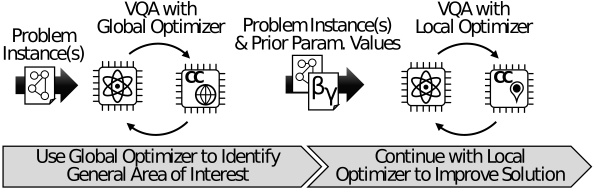
Chain different optimizers with different scopes or strengths together. As indicated in the solution sketch below, a global optimization strategy can be combined with a subsequent local optimizer. The former would determine a general area of interest in the overall optimization landscape. Afterward, the local optimizer is started from a point in this area of interest and searches on a smaller scale, aiming to find the global optimum.
Result
By chaining optimizers, the subsequent optimizers utilize previously obtained results as starting points to improve upon. Thereby, optimizers are combined to benefit from their respective strengths and achieve cost-efficient optimization.
Examples
–
Related Patterns
This pattern refines the Warm-Start pattern and can be applied in conjunction with VQA, including QAOA, [Weigold et al. 2021a]. It is similar to the Variational Parameter Transfer pattern, with an unaltered problem instance, while the algorithm in use, specifically the optimization algorithm, is exchanged instead.
Known Uses
[Rad et al. 2022] use this method to avoid barren plateaus in VQAs. Tao et al. apply it in a QNN optimization [Tao et al. 2023]. Wauters et al. supplement their Reinforcement Learning-based optimization approach for QAOA with subsequent gradient-based local optimization [Wauters et al. 2020] .