Extended Quantum Computing Patterns
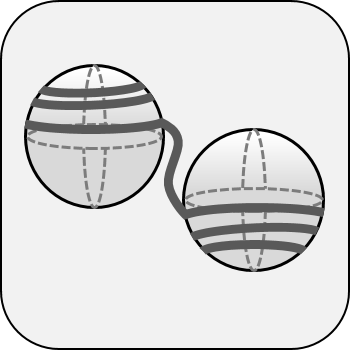
Creating Entanglement
Aliases: –
Tags:
© https://link.springer.com/chapter/10.1007/978-3-030-14082-3_19
Intent
Enforce a strong correlation between qubits by entangling them.
Context
Entanglement is a unique characteristic of quantum mechanics and one of the causes for the power of quantum algorithms (Bruß and Macchiavello 2011).
Although entanglement is not necessarily needed for a powerful quantum algorithm (Biham et al. 2004), it is required to achieve an exponential speedup over classical algorithms (Jozsa and Linden 2003).
Consequently, a quantum register is often entangled for further processing after the Initialization.
Forces
–
Solution
There exist numerous approaches for the creation of an entangled state. For example, entanglement can be created by a Boolean function \(f:\{0, 1\}^n \rightarrow \{0, 1\}^m\), a corresponding unitary operation
and a Uniform Superposition in the first \(n\) qubits of the quantum register:
The resulting state is entangled. For \(f = id\), \(U_{f}=CNOT\) and consequently \(CNOT \left(H \otimes I \right) \left( \left| 0 \right> \otimes \left|0 \right> \right)\) is entangled.
Result
Unitary transformations that create entanglement must include multi-qubit operators such as CNOT.
Such operators typically have a lower gate fidelity than single qubit operators and therefore increase the overall gate error.
Examples
–
Related Patterns
A quantum register must make use of Initialization before entanglement can be created. Applying \(U_{f}\) as described above computes a Function Table and makes use of Uniform Superposition.
Known Uses
Most algorithms use entangled states. A Function Table may create an entangled state, by making use of the above-defined unitary operation \(U_f\) of a Boolean function \(f\).
Quantum Phase Estimation (PlanQK) Grover's Algorithm (PlanQK) Deutsch algorithm (PlanQK)