Extended Quantum Computing Patterns

Gate Error Mitigation
Aliases: –
Tags:
© https://www.thinkmind.org/index.php?view=article&articleid=patterns_2022_2_10_70007
Intent
How to reduce the negative impact of noisy gate executions such that the pre-measurement state is closer to the expected error-free state?
Context
A NISQ-compatible quantum algorithm, e.g., VQE, needs to be run on a quantum device. The device’s gate implementations are error-prone, causing errors in the quantum computation. To obtain precise results for the executed algorithm, the measured state needs to be computed accurately. Thus, it is crucial to mitigate the effects of gate errors.
Forces
The execution of gates on current NISQ devices is not perfectly accurate. Hence, every execution of a gate causes a minor error. These errors keep accumulating, eventually making large computations impossible. The pulses used for the implementation of gate operations can be controlled on many quantum devices. Therefore, custom pulse schedules can be used to individually calibrate gates. Furthermore, the capabilities of current quantum devices are limited, e.g., the number of qubits and the decoherence times are bound. Thus, minimal additional quantum resources, such as gates and qubits, shall be used for error mitigation.
Solution
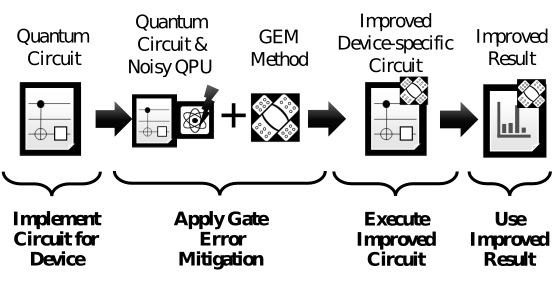
Mitigate the impact of gate errors by applying a Gate Error Mitigation (GEM) method. The mitigation of gate errors has to be performed before the execution of the quantum circuit, as occurring errors otherwise accumulate during the computation, making it difficult to retrace them. The resulting pre-measurement quantum state is closer to the expected error-free state, therefore, providing more accurate measurement results. The figure below depicts a solution sketch for GEM. First, the circuit is implemented. Afterwards, a GEM method is applied, modifying the circuit, to generate a more precise implementation for the selected device. The circuit modifications can range from simple gate additions over custom gate pulse adjustments to full circuit rewrites based on Machine Learning (ML). Next, the improved circuit is executed on the quantum device. Finally, the improved measurement result can be evaluated to obtain a more precise solution.
Result
GEM can significantly reduce the impact of errors caused by erroneous gate executions. As a consequence, the state computed by the quantum algorithm is closer to the expected error-free quantum state and a more precise algorithm result can be obtained. However, the mitigation process may induce additional quantum gates into the circuit or require classical pre-processing to calculate optimal device calibrations, e.g., gate pulse calibrations. Generally, GEM methods can be used in combination with other error mitigation methods, such as REM to reduce the overall error further.
Examples
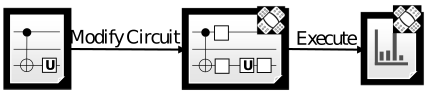
The figure below shows the process of a typical gate addition-based method. These methods mitigate gate errors by adding additional gates to the quantum circuit that balance out gate errors. The initial quantum circuit is modified by adding specific gates for each error-prone operation. Hence, the depth of the circuit increases significantly. Therefore, the device’s decoherence times need to be kept in mind, as otherwise, the mitigation might decrease the result quality.
 The figure below depicts the typical process of a pulse calibration method. First, the pulse calibrations for the device are generated, e.g., it is determined which frequency is perfect to perform a bit-flip operation on a specific qubit. Once all required frequencies are determined, the information can be incorporated into the quantum circuit. When executing the modified circuit, the custom pulse calibrations will now be used instead of the default values. More precise pulse calibrations make gate executions more accurate, thus, decreasing gate error rates and increasing the solution’s precision
Related Patterns
Known Uses
Several circuit adjustment methods, e.g., FIIM or Random Identity Insertion (RIIM), are presented in the literature [Nachman et al.],[Temme et al.],[Harper et al.]. Further, machine learning-based circuit adjustment methods have been introduced, e.g., Noise-Aware Circuit Learning (NACL) [Cincio et al.]. Moreover, pulse modification-based GEM methods have been presented [Carvalho et al.],[Giurgica-Tiron et al.].