Extended Quantum Computing Patterns
Quantum Hardware Selection
Aliases: –
Tags:
© M. Beisel, J. Barzen, F. Leymann, and B. Weder, Operations Patterns for Hybrid Quantum Applications, in Proceedings of the 15th International Conference on Cloud Computing and Services Science (CLOSER). SciTePress, 2025.
Intent
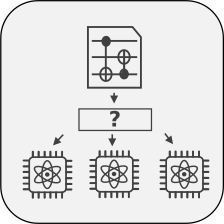
How to automatically select a suitable quantum device to execute a given quantum circuit?
Context
Quantum circuits can either be executed on a quantum device or a classical computer simulating the computation. However, it is impossible to simulate larger quantum circuits using classical hardware [Zhou et al., 2020]. Therefore, a suitable quantum device for the execution must be selected.
Forces
Quantum devices are provided by different vendors, e.g., IBM, IonQ, and Rigetti [Leymann et al., 2020]. These quantum devices are very heterogeneous and differ in characteristics, such as the number of qubits, their decoherence times, or the supported gate set [Weder et al., 2021a]. Some of the characteristics change over time, e.g., the decoherence times when recalibrating the quantum device [Tannu and Qureshi, 2019)]. However, the successful execution of a given quantum circuit depends on these characteristics [Salm et al., 2020]. Thus, selecting an unsuitable quantum device can lead to error-prone results. Quantum cloud offerings also differ regarding their payment models and access methods, e.g., queue based systems or reservations of exclusive time slots.
Solution
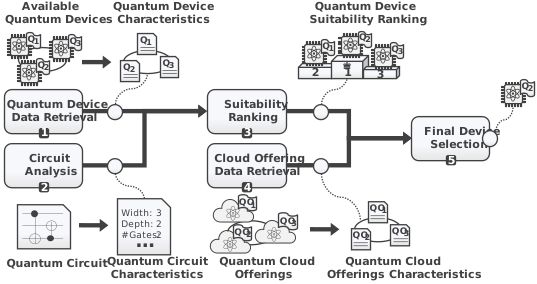
Figure 4 gives an overview of the phases to select suitable quantum devices. In the first step, the characteristics of the quantum devices available to the user are retrieved. This can either be done by periodically accessing an API providing live data about these characteristics, e.g., a provider API or a dedicated provenance system, or by executing benchmarks that approximate device characteristics [Amazon, 2024], [IBM, 2024a], [Weder et al., 2021a]. Then, analyze the given quantum circuit so that in the next phase the suitability of the devices can be ranked based on the characteristics of the circuits and devices [Salm et al., 2020]. Finally, ensure that a quantum device is selected that is available via a suitable cloud offering, e.g., a cloud offering supporting a pay-per-use model.
Result
The quantum circuit can be executed on the selected quantum device. Proper hardware selection might reduce the impact of errors and can optimize other factors, such as the waiting time, depending on the user goal. If the format of the circuit is incompatible with the selected device, it must be translated.
Examples
–
Related Patterns
The Unified Execution pattern can be used to execute the quantum circuit if the circuit format is not supported by the selected quantum device. The Prioritized Execution pattern [Georg et al., 2023] enables selecting a suitable quantum device even if the respective queue is long by providing prioritized access to the quantum device. Since errors still occur when utilizing a suitable quantum device, their impact can be reduced by applying the Readout Error Mitigation and Gate Error Mitigation patterns [Beisel et al., 2022].
Known Uses
Salm et al. Salm et al., 2020 and [Quetschlich et al., 2023] introduce tools to automatically select suitable quantum devices based on given quantum circuits. [Suchara et al., 2013] present the QuRE Toolbox, a framework to estimate the required resources for executing quantum circuits. This information can then be used to select a suitable quantum device. Qiskit provides functionalities to filter available quantum devices based on different characteristics, e.g., the minimum number of qubits or the supported gate set [IBM, 2024b]. Further, the quantum device for the execution can be selected from the remaining quantum devices based on their current queue size.