Extended Quantum Computing Patterns
Standalone Circuit Execution
Aliases: –
Tags:
© https://www.scitepress.org/Link.aspx?doi=10.5220/0012057700003538
Intent
How to execute standalone quantum circuits that impose no deployment or integration requirements?
Context
In some scenarios, only standalone quantum circuits need to be executed, such as circuit design and testing or education. Thereby, it is beneficial to execute quantum circuits with minimal effort and required knowledge about different quantum offerings as well as deployment or integration technologies.
Forces
Quantum offerings vary in features and capabilities. Use of advanced offerings for simple use cases may incur unnecessary management overhead and even block the task due to lacking technical expertise, e.g., deployment automation and integration technologies. In contrast, certain quantum offerings reduce the amount of required management efforts, e.g., by generating execution requests automatically.
Solution
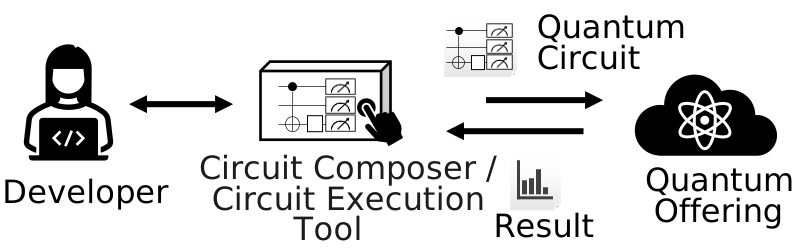
Execute quantum circuits via quantum offerings that do not require implementing custom deployment logic or integration with other services. Figure 2 shows the solution sketch in which distinct quantum circuits are executed using offerings capable of creating and executing circuits. This includes dedicated graphical circuit composers or text-based tools transmitting the quantum circuits to the offering. Typically, providers are responsible for the majority of the management efforts, e.g., deployment of circuits and authentication to the underlying quantum offering.
Result
Quantum offerings supporting this pattern provide a simple way for executing quantum circuits. However, classical pre- and post-processing steps can not be defined using these offerings. Thus, this style of execution is not suitable for running larger quantum applications and integration with external applications is either very limited or not supported at all. Additionally, running computations with this pattern cannot take advantage of prioritized executions.
Examples
–
Related Patterns
In scenarios when quantum circuits are executed for testing purposes and afterwards require the integration with classical pre- and post-processing steps, the AD-HOC HYBRID CODE EXECUTION can be used. Additionally, different quantum computing patterns can be used while modeling quantum circuits, e.g., AMPLITUDE AMPLIFICATION or UNIFORM SUPERPOSITION [Leymann, 2019].
Known Uses
Vendors such as IBM [IBM, 2023b] or Pasqal [Pasqal, 2023] support this pattern via graphical circuit composer services that enable modeling quantum circuits visually and executing them from the GUI, hence, abstracting away the authentication and construction of the invocation request.