Extended Quantum Computing Patterns
Readout Error Mitigation
Aliases: –
Tags:
© https://www.thinkmind.org/index.php?view=article&articleid=patterns_2022_2_10_70007
Intent
How to reduce the impact of erroneous measurements such that the measured result is closer to the intended quantum state?
Context
A NISQ-compatible quantum algorithm, e.g., QAOA or VQE, needs to be run on a quantum device. The device’s decoherence times are short and the measurement operations are error-prone. Hence, the measured probability distribution is inaccurate, even when the measured quantum state is accurate. Thus, the negative impact of readout errors needs to be mitigated to obtain a precise measurement result.
Forces
The measurement times of quantum computers in the NISQ era are significant in comparison to their decoherence times. Therefore, the measurements are highly error-prone and often are among the main error sources. Due to the limited capabilities of current NISQ devices, a minimal number of additional qubits and quantum gates shall be used for the mitigation of readout errors. Further, a quantum device’s measurement error rates change over time, thus the Readout Error Mitigation (REM) needs to be adaptive.
Solution
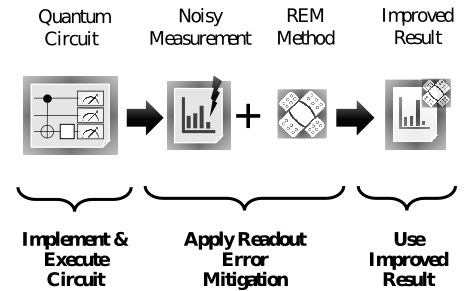
Mitigate the impact of readout errors by applying a REM method. The mitigation method is performed after the circuit execution and adjusts the measured probability distribution. The resulting mitigated probability distribution is a more accurate representation of the intended quantum state. A solution sketch for the application of REM is shown in figure below. First, the quantum circuit is implemented and executed. Then the resulting probability distribution is improved based on measurement characteristics collected for the quantum device. These characteristics are typically obtained by separately running so-called calibration circuits. Alternatively, adapted instances of the implemented circuit can be run to obtain additional information about the measurement properties.
Result
REM can reduce the impact of errors caused by measurement operations. The resulting, more precise probability distributions make NISQ devices more suitable for real-world use cases. However, additional classical processing is necessary, which can significantly increase the runtime and classical resource requirements, as not all mitigation methods scale well with the number of qubits. Generally, data provenance can be employed to increase the efficiency of frequently occurring REM tasks, e.g., when executing a VQA.
Examples
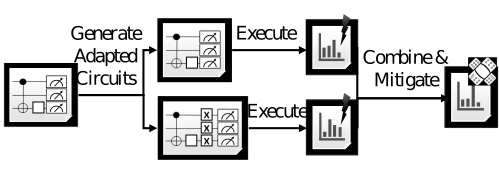
The figure below illustrates the steps of the Static Invert-and-Measure (SIM) technique[Tannu et al.]. First, multiple slightly adapted instances of the circuit are created. Thereby, bit-flips are added right before the circuit’s measurement operations. This helps to detect erroneous measurements because readout error rates are typically higher when measuring a qubit in the \(\ket{1}\) state than when measuring it in the \(\ket{0}\) state. Once all circuits are executed, the measurement results are processed, returning the mitigated probability distribution.
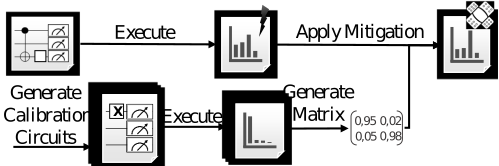
The figure below shows the typical process of a calibration matrix-based mitigation method. Multiple shallow calibration circuits are generated and executed. The resulting probability distributions give information about the device’s readout error rates. These error rates are then incorporated into a so-called calibration matrix, which can be used to mitigate readout errors. For example, this can be done by multiplying the inverse of the calibration matrix with the circuit’s measurement result.
Related Patterns
Known Uses
Various REM methods, e.g., calibration matrix-based [Bravyi et al.][Nachman et al.][Maciejewski et al.][Nation et al.] or bit-flip-based [Tannu et al.][Smith et al.],have been introduced in the literature. Moreover, recent work introduces a deep learning-based REM method [Kim et al.].