Extended Quantum Computing Patterns
Unified Observability
Aliases: –
Tags:
© M. Beisel, J. Barzen, F. Leymann, and B. Weder, Operations Patterns for Hybrid Quantum Applications, in Proceedings of the 15th International Conference on Cloud Computing and Services Science (CLOSER). SciTePress, 2025.
Intent
How to ensure reproducibility, understandability, and quality when executing hybrid quantum applications?
Context
Quantum applications comprise a multitude of classical programs and quantum circuits which are typically executed in a heterogeneous execution environment, e.g., utilizing classical and quantum cloud offerings [Beisel et al., 2024], [Leymann et al., 2020].
Forces
When executing hybrid quantum applications in heterogeneous execution environments, collecting all necessary data is difficult: The data must be gathered using the different APIs or SDKs of the utilized quantum and classical cloud offerings, which often change, e.g., when new features are released. Furthermore, the offerings might not provide all the required data Weder et al., 2021a. Finally, some of the data also changes over time, e.g., the qubit decoherence times or the error rates [Tannu and Qureshi, 2019]. Analyzing the data is complicated by different data formats and abstraction levels of the provided data [Beisel et al., 2024]. Moreover, hybrid quantum applications are typically developed and operated by interdisciplinary teams with various backgrounds, e.g., physics, mathematics, and software engineering, requiring different information [Weder et al., 2022].
Solution
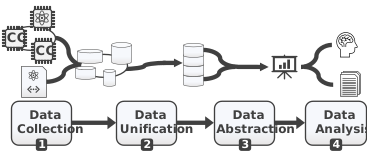
Figure 6 shows the phases required to achieve unified observability. Data about the execution of the quantum application and the used quantum and classical resources must be collected continuously. Persistently store these data using a provenance system that automatically unifies data using transformation methods. For example, quantum cloud offerings use both the fidelity and error rate metrics to describe the quality of their gate operations, where Error Rate = 1−Fidelity. Use benchmarks to retrieve data that is not provided by the cloud offerings but required by the user [Tomesh et al., 2022]. To enable user-group-specific monitoring and analysis provide suitable abstractions, e.g., by aggregating data or hiding unnecessary information [Beisel et al., 2024].
Result
The provenance system stores all relevant data produced by the quantum applications, enabling their monitoring and analysis, e.g., to identify errors and optimize the application. Data abstractions facilitate understanding the application and its execution environment, particularly by visualizing crucial data.
Examples
–
Related Patterns
The Unified Execution pattern can be combined with the Unified Observability pattern to monitor and analyze the execution of quantum applications using heterogeneous hardware. The stored data about quantum devices can be used as a basis for the Quantum Hardware Selection, Gate Error Mitigation, and Readout Error Mitigation patterns [Beisel et al., 2022].
Known Uses
[Beisel et al., 2024] introduce a concept to unify the observability of hybrid quantum applications realized using workflows within heterogeneous multi-cloud environments. Weder et al., 2021a present a provenance system for quantum computing automatically gathering required provenance data, which can be used for monitoring and analysis.